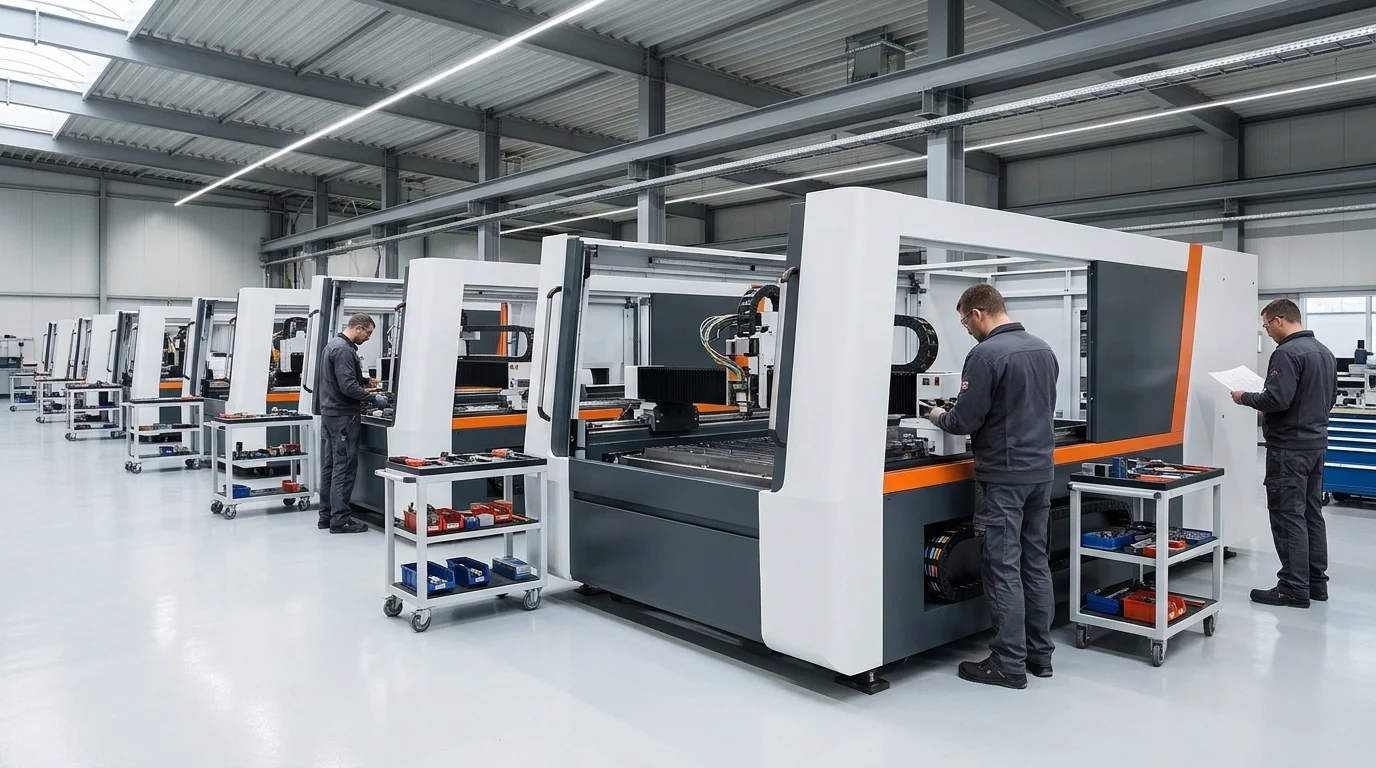
Laser power is the single biggest factor in the price of a fiber laser cutting machine, and also the easiest place to overspend or underspend. This guide explains how to match power to your materials and production volume.
1. Start with your thickest regular job
Look at the parts you cut every week, not the rare one-off job. If 90% of your work is 1–6 mm sheet, a 3 kW machine will cut it quickly and economically, and you can outsource the occasional 20 mm plate.
| Laser power | Carbon steel | Stainless steel | Aluminum |
|---|---|---|---|
| 1.5 kW | up to 14 mm | up to 6 mm | up to 4 mm |
| 3 kW | up to 22 mm | up to 12 mm | up to 10 mm |
| 6 kW | up to 25 mm | up to 20 mm | up to 16 mm |
| 12 kW | up to 40 mm | up to 35 mm | up to 30 mm |
2. More power means more speed on thin sheet
Higher power is not only for thick plate. On 2 mm stainless steel, a 6 kW laser cuts roughly twice as fast as a 3 kW laser. If your machine runs in two shifts, that extra throughput can pay back the price difference within a year.
3. Consider your assist gas costs
High-power lasers can cut carbon steel with compressed air instead of oxygen or nitrogen, which dramatically reduces running costs for thin and medium sheet.
4. Our recommendation
- Start-up job shops: 1.5–3 kW open-type machine such as the IF-F3015.
- Growing fabricators: 6 kW with an exchange table to keep the laser busy.
- Thick plate and high volume: 12–20 kW enclosed machine such as the IF-F3015E.
Not sure which power fits your shop? Send us a few typical drawings and we will run a free cutting test and recommend the most cost-effective configuration.